Science is his sword.
The rest is written. It is published in November. Subscribe to the Metanoia Project newsletter and you will have it the day it is out, or join the Project and help finish it.
Part one · The weirdness
Part two · The wager
Part three · If it is real
End matter
This is a working draft, published with its seams showing. Where the text is not yet finished the document says so, in the margin of the line itself: gap marks a passage not yet carried across from the master; author a place only the author can fill; verify a citation still to be checked; source a reference still to be confirmed; draft wording standing in until it is replaced.
The notes beneath those lines are the author’s own working notes. They have been left in rather than tidied away. Paragraph numbers are stable and may be cited.
…but the sword
John Milton, Paradise Lost, Book VI
Of Michael from the Armorie of God
Was giv’n him temperd so, that neither keen
Nor solid might resist that edge…
I once watched two scientists discuss a thing they did not understand, and they did so with such lively curiosity, and such humility before what they did not know, that I became aware I was watching a spiritual act. One of them never explained the scientific method, but I saw in the way he held it that he treated it as a holy thing, a way of approaching truth without presuming to own it.
As he spoke, an impression formed in my mind. I saw him kneeling before a tabernacle, dressed in the garb and robes of a Catholic priest, and in an instant I could see clearly that he was, in his own way, worshipping, serving and tending to truth.
I have long held that those who serve truth serve God, because God is truth.
I had lost faith, as many have, in scientists, who had stopped being people who look and become people who are cited, and who had learned, when the public asked them a question, to answer with their credentials.
I had lost faith in science, which had let itself become a word that ends arguments instead of starting them, so that “the science says” came to mean “stop asking.” I had lost faith, too, in its hubris and in its relentless war on God.
Peter Thiel has argued since 2011 that outside the computer the world of things has barely moved since 1970, and that the universities are the Church before the Reformation, selling degrees the way Rome sold indulgences. verify
And I had also lost faith in the method itself, because I had only ever seen it in those hands, held up like a seal of office, and I had taken the seal for the thing.
The great questions had been declared closed by people who had never gone near them, and the academy had become everything it accused the Church of being: rich, certain, and sure that whatever it could not see was not there.
What happened to me is what happens when a man disgusted by the Church, by its corruption, its evasions and its self-regard, meets just once a single holy priest and is convicted on the spot: Ah, so this is what it was supposed to be!
One honest man becomes a doorway to what the institution had hidden. The righteous scientist was that doorway for me, and through him I came, for the first time, to see the significance of the scientific method.
I feel my way through life. I have never understood something until I have seen another person love it first, and in that moment I understood what this great tool was.
In his hands I finally saw what the method is and what it is not.
The method is a cruel mistress. She is almost never satisfied: she says no, not good enough, come back tomorrow, and she says it again the next day and the day after, regardless of how badly you want the answer.
But she is also a forgiving lover, and this is the part the materialist forgets.
Her no is never final. She does not say that a question is settled, only that it is settled to her standard, by her rules, for today, and that one may try again tomorrow.
Because she rules only in the present tense, she cannot close the future. The materialist takes her verdict for today and reports it as a verdict forever, and that single mistranslation is the whole of his error.
There is another kind of materialist, worse than the gluttonous friar: he shapes from her the image of a god, stands before the lost and hungry multitude, and thrusts the idol of his own making above his head in triumph.
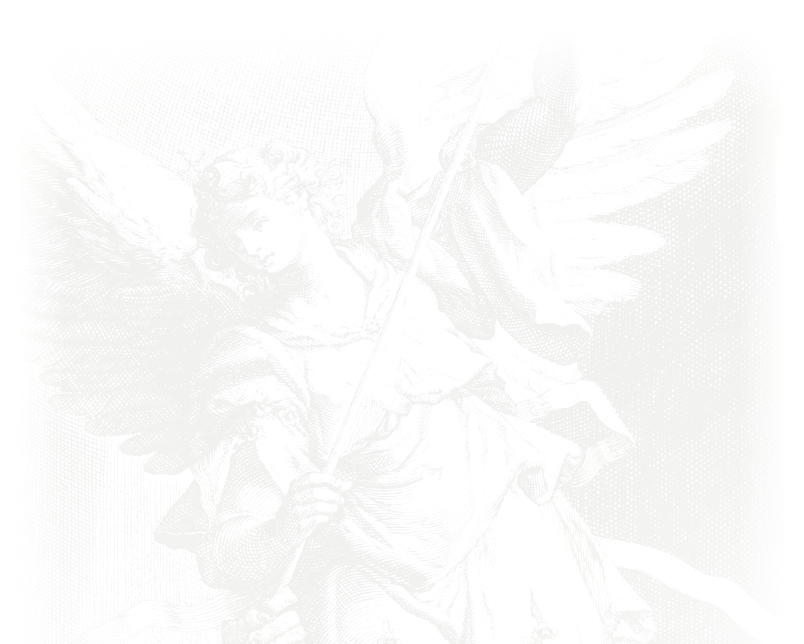
There is a painting in Rome, in a Capuchin church built above a crypt lined with the bones of thousands of friars, which Guido Reni painted in 1635. It shows the Archangel Michael standing with one foot on the head of Satan and a sword raised over him. The painting did not stay in Rome: copies of it spread across the Catholic world, into churches, onto statues and, above all, onto prayer cards, and Reni’s Michael became the Michael, the one most people see when they hear the name. People have carried it in wallets and missals and pinned it above beds. I do not think they carried it as art; I think they carried it as hope, a small printed promise that the thing under his foot can be beaten.
I have pondered this painting for a long time, and what it means that so many people have needed it. Reni’s Saint Michael the Archangel shows Satan subdued rather than destroyed: pinned and held still, with the sword raised but not yet fallen.
For most of history the only instruments we had for subduing him were prayer and the rite.
I came to believe there may now be another way.
After years of rejection by the Church, and by those whose responsibility it was to care for me, I turned to novel methods. The first was MDMA. I had heard talk of its potential to heal trauma, and by then I suspected that this phenomenon was deeply tied to trauma, or at least anchored in it. I obtained some MDMA and replicated the protocol used in the MAPS trials: an eye mask, a set playlist of music, and a dose of 120 milligrams. It was not an easy decision. I have struggled with addiction for most of my life, and I was afraid this was my addiction finding another way to make me relapse. But I had been living with this phenomenon for three years, and I was desperate for help.
When the drug took hold, I was overwhelmed by a sense of safety I had never felt before, so profound that I still cannot put it into words. I relaxed into it and must have fallen asleep. Then, out of nowhere, I exploded in a surge of primal rage, and within the rage I felt an intelligence. I writhed on the bed, clawing towards the ceiling, snarling, growling and roaring. It went on for what felt like a minute or two. Then I heard a voice within me, and it said one word: enough. I fell into a deep peace, and the rage and the presence evaporated at once. I lay there stunned. Until then I had only my own belief that I was possessed. This was the first time I had experienced it completely, in my body.
I kept taking MDMA, and it brought further experiences I would call mystical, all of them valuable. What interested me most was that it produced the same bodily signs as a charismatic deliverance session, or very nearly: burping, yawning, breaking wind, retching, vomiting, shaking and tremors. Others around me who suspected that they too were demonised tried it at my encouragement. One woman began to dance, moving her hips provocatively, and something began to manifest, rising up through her body and into her throat as if trying to leave. I became fascinated by the idea that a chemical could trigger these experiences. In online forums I found other people who had been through the same thing. They framed it differently and understood it differently, but they had had the same experience.
That was probably the foundational event behind everything that follows. It made me believe in a future in which science and religion are reconciled, and in which we might develop new treatments for states of possession. As I went on, I found that possession states and exorcisms also occur under other compounds, and under accelerated breathing, as in holotropic breathwork. All of this is set out in Part one.
I also began to see what was missing from the Catholic and other Christian deliverance ministries: a safe container, methods, proper protocols, consideration for the person, and any willingness to ask questions. Being theologically correct came before the care and treatment of the person who was suffering. I began to trust myself, and to trust that what I was experiencing was legitimate. I have been told with confidence that this phenomenon does not exist, and that what I feel is a tactile hallucination. I know that this is not true. The movements of energy I feel within my body are directed and specific. I came to believe that I was not simply feeling it but detecting it, and that if I was detecting it, there was a mechanism of detection within me.
By science I do not mean the academy but the method: the tools, the protocols, the rigour. The method does not belong to whoever holds it now; it answers to anyone willing to submit to its discipline. I am not a scientist, and what I can do is point. The sword must now be turned on the demonic phenomenon.
I studied the religions, and I studied the science and the research on this phenomenon, and found the research thin. No one had studied it where the fields converge, and few had even asked the questions. I began to imagine what science could do for its treatment, for diagnosis and for long-term outcomes. I believe that religion and science are the two pillars on which Western civilisation was built, and I now believe that the survival of human consciousness depends on their reconciliation. Scientific method, rigorous research and development, joined to the metaphysical truths handed down by centuries of mystics, may point us towards victory over this phenomenon.
As I pondered that painting once again, I came to one singular conclusion that would begin to shape my whole life.
Science is his sword.
Nothing in this paper is medical advice, and it diagnoses nobody. Much of what follows describes people in danger. If you are in danger yourself, or afraid for someone else, that is for a doctor or an emergency department now, and not for a paper. In Ireland the Samaritans answer on 116 123, free, at any hour.
Listen
On Spotify ↗Part one · The weirdness
Part two · The wager
Part three · If it is real
Conclusion
Version one is in review. Be told when it is published.
Science is his sword.
The rest is written. It is published in November. Subscribe to the Metanoia Project newsletter and you will have it the day it is out, or join the Project and help finish it.